Don't pet that bison!
DATE
25 August 2026
Friendly or dangerous?
I think bison are both majestic and very cute, and apparently I’m not alone in that sentiment. A quick google search yields baby bison with soft-looking fluffy fur, cute cartoons, and AI-generated content to make them look even cuter!

Look at all these cuties!
But before you pack your car and drive to Yellowstone to pet a cute baby bison, let me deliver a warning:
Bison are wild and dangerous animals.
Bison injure more people than any other animal at Yellowstone National Park. We should note that they are the most abundant large animal, outnumbering grizzly bears with 5,300 bison compared to 1,030 grizzlies. Anecdotally, I have found much more education and warning on the dangers of grizzly bears than bison. Strange.
Some cool bison facts
They’re huge. Male bison weigh up to 2,000 lbs and female bison weigh up to 1,000 lbs
They’re fast. Bison run up to 35 mph, which is 7 miles faster than Usain Bolt, humanity’s fastest runner.
They’re agile, able to clear 6ft so fences are a joke.
They’re easily spooked and aggressive especially during mating season or when protecting offspring.
Knowing all this, I still think bison are super cute. I definitely won’t get close to one…But wait. What about this video of a friendly bison on Instagram (source)?
Or this video on TikTok of someone riding an albino bison?
Can they be domesticated or are these people bison-whisperers? The answer is neither. As you may have guessed, these are videos created by generative AI. They are not real. In fact, the first video I found from a website that actually helps you make more believable fake content using its AI tool as well as providing tips on video editing and even human psychology. We need to become smarter content consumers.
What exactly is generative AI?
If you've spent any time on the internet in the last few years, you probably noticed how AI, short for artificial intelligence, use has exploded and permeates through every aspect of lives. This includes social media. AI is not new and there are many types of AI. In this writing, when I say AI what I am really referring to is generative AI, a form of AI that can produce new content. This includes text, images, video, audio, and synthetic data. Generative AI itself is based on machine learning algorithms all the way back in the 1950s (Foote, 2025).
Generative AI can be used for fun and playful creative endeavors such as imagining yourself as a pirate, envisioning your dream home based on a description of your personality, moodboards, and so on. It can also be used to help society through innovations such as in healthcare, through medical simulations and drug discovery. There are many ethical issues with generative AI that I won’t go into here such as stolen artwork, privacy, biases and environmental issues. AI is polarizing but there is no doubt that it has its benefits.
One consequence of AI use that I will go into here is its effect on wildlife conservation.
Generative AI and wildlife conservation
Recent studies on generative AI use in social media and its effects on wildlife conservation have found…
Click to read more details ↓
1
Perpetuates biases
Digital content is biased towards mammals, also known as taxonomic bias. AI perpetuates this and could skew public attention and therefore conservation funding away from lesser known species. (Guerrero-Casado et al., 2025). AI training data is also biased, favoring male, US-based academic sources. Indigenous peoples are underrepresented in AI training data despite deep cultural ties to wildlife. (Wearn et al., 2019; Sandbrook, 2024, citing Urzedo et al., 2024)
2
Blurs reality and fantasy
Realistic AI-generated content depicting inaccurate wildlife and and wildlife encounters hinders identification efforts, reduces biodiversity literacy in children, and create a false sense of safety or false sense of abundance, leading to dangerous behavior from misinformed humans. (Guerrero-Casado et al., 2025)
3
Normalizes danger, making wild animals seem less wild
False sense of species security — realistic fake footage can make endangered species appear more abundant or less at risk, undermining perceived urgency for conservation action (Guerrero-Casado et al., 2025) Physical danger — normalized portrayals of wild animals as safe or affectionate could cause people to misjudge real encounters as non-threatening (Guerrero-Casado et al., 2025)
4
Makes conservation research more difficult
Social media perpetuates and rewards misinformation through engagement, which contaminates data, hindering ecological research and educational outreach. (Guerrero-Casado et al., 2025; Mikula et al., 2026) Hyper-realistic fake content, rewarded by the same engagement metrics used for real outreach, dilutes accurate science communication (Guerrero-Casado et al., 2025; Mikula et al., 2026) AI-generated content increasingly pollutes the web/social media sources ecologists mine for occurrence records and behavioral data, making that data harder to trust and filter (Guerrero-Casado et al., 2025, as cited in Mikula et al., 2026)
AI-generated content (images, video, writing) of wildlife are increasingly blurring the line between authentic and synthetic, especially on social media. This impacts public perception of conservation science and fundraising. However, no clear guideline exists to hold creators or platforms accountable for this kind of misinformation.
As AI systems grow more powerful and autonomous, the frameworks meant to govern them consistently lag behind. Since policies are slow to develop…Is there a way social media platforms can educate users in the mean time?
Make learning fun again
What if we employed AI to scan social media feeds for AI content? The AI could occasional present a quick little game asking if you think the image is real or not. This tests your knowledge in a quick, low-consequence way. Afterwards it can give tips as to why the image is fake. Over time, perhaps everyone would become better at detecting AI-generated content.
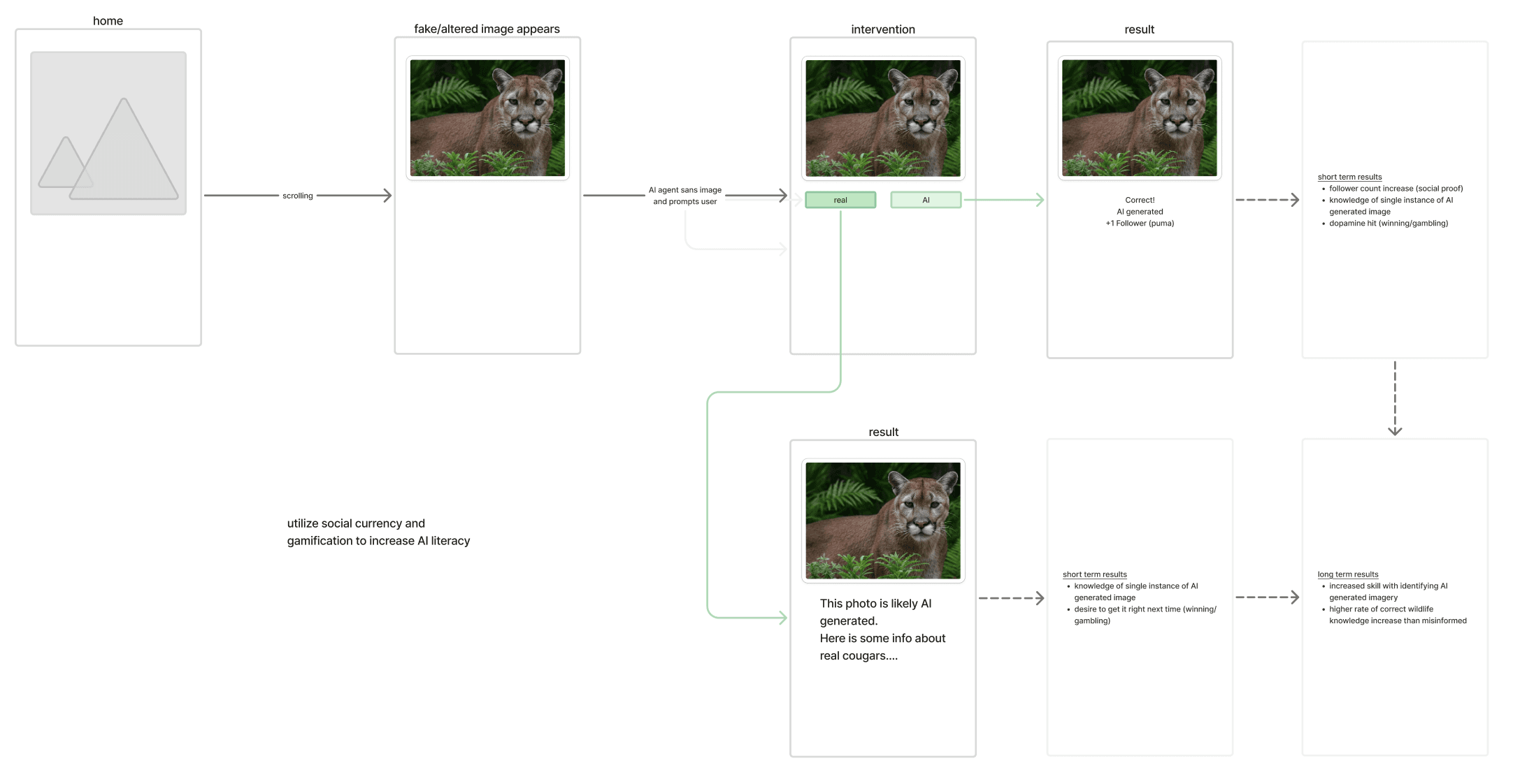
Flow of how the AI feature in a social media app could work
Don't pet that bison, no matter how cute it may look.
Although it would be helpful for governing bodies to control the spread of misinformation (which some may argue violates free speech) that isn't happening any time soon. Although companies could create and implement better guard rails for AI-generated content, the reality is they don't because they have no reason to. There is no monetary or law that incentivizes them to. So it's up to us regular people to become smarter (aka gaining tech and media literacy).
Consume media with a critical eye. Are there tags that signify AI creator? Is there something off about an image or video? Follow real accounts that post real science-based content.
Finally, I’ll leave you with this doodle. Remember that wild animals are just that – wild.

References
Foote, K. D. (2025, September 10). A Brief History of Generative AI. Dataversity. https://www.dataversity.net/articles/a-brief-history-of-generative-ai/#the-2020s-and-smarter-chatbots
Guerrero-Casado, J., Murillo-Jiménez, T., Carpio, A.J., Tortosa, F.S., & Serrano-Rodríguez, R. (2025). Threats to conservation from artificial-intelligence-generated wildlife images and videos. Conservation Biology. https://doi.org/10.1111/cobi.70138
Jackson, J. (2026, June 29). How Dangerous are Bison, Really?. Yellowstone National Park Trips. https://www.yellowstonepark.com/things-to-do/wildlife/yellowstone-bison-attacks/
Lindgren, H. (2025). Emerging Roles and Relationships Among Humans and Interactive AI Systems, International Journal of Human–Computer Interaction, 41:17, 10595-10617, https://doi.org/10.1080/10447318.2024.2435693
Mikula, P., Dylewski, Ł., & Tryjanowski, P. (2026). Social media and the illusion of conservation impact. Conservation Science and Practice. https://doi.org/10.1111/con4.70070
Mowbray, S. (2026). Wildlife attacks and strange animal behavior — fake images spark conservation concerns. Mongabay Conservation news. https://doi.org/10.66709/news-313184
Sandbrook, C. (2024). Beyond the hype: Navigating the conservation implications of artificial intelligence. Conservation Letters. https://doi.org/10.1111/conl.13076
Wearn, O.R., Freeman, R. & Jacoby, D.M.P. (2019). Responsible AI for conservation. Nat Mach Intell 1, 72–73 (2019). https://doi.org/10.1038/s42256-019-0022-7
When AI Rewrites the Wild. (2025). Conservation Frontlines. https://conservationfrontlines.org/2025/12/ai-wildlife-videos-conservation/
"Wildlife doesn’t need more fantasy. It needs a public that understands what’s actually happening on the ground. Every fake clip that goes viral makes that harder.
The path forward is simple: tell real stories, amplify real science, and teach people how to spot manufactured wildlife from the truth of the field.
Conservation succeeds when people see the wild for what it is – not what an algorithm dreams up."
- Conservation Frontlines